
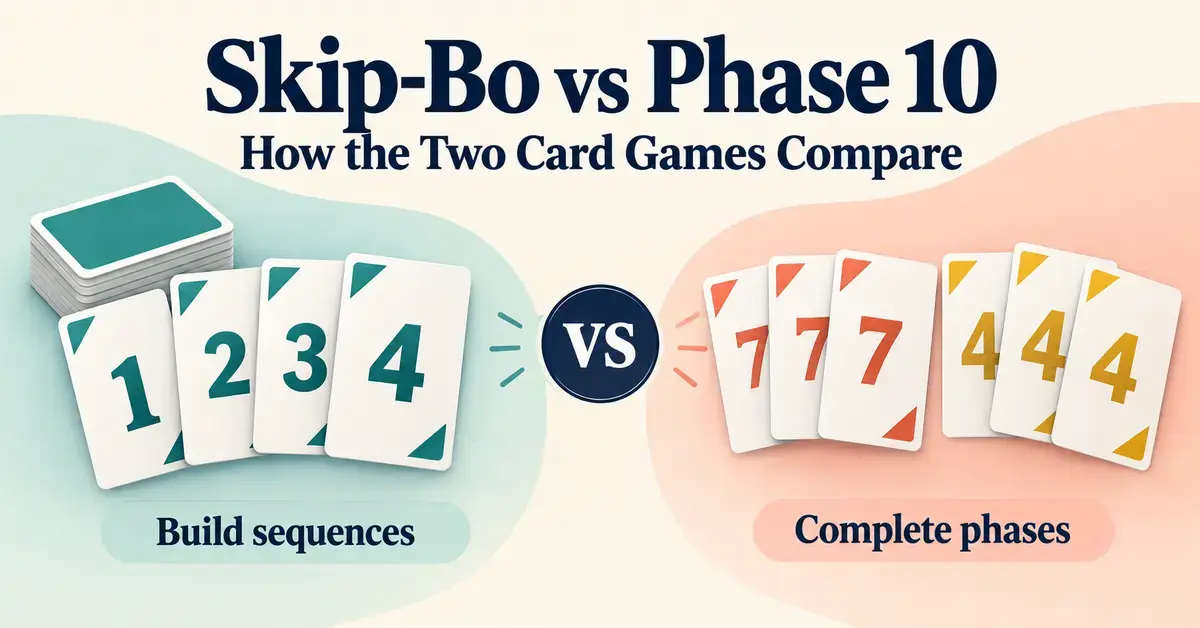
Skip-Bo and Phase 10 are two of the best-loved card games in Mattel’s family line-up, and they are often bought together or mixed up with each other. Both use a special deck rather than a standard pack of playing cards, both play with two to six people, and both are aimed at ages seven and up. Yet the way you actually play them is very different: one is a fast sequencing race, the other a longer, puzzle-like challenge. This guide compares Skip-Bo and Phase 10 on their rules, components, difficulty, game length and who each one suits, so you can pick the right box for your table.
What Skip-Bo and Phase 10 have in common
Before the differences, it helps to see why these two games feel like cousins. They share a surprising amount:
- Same publisher. Both are sold by Mattel today, alongside Uno and other family card games.
- Player count. Each supports 2 to 6 players.
- Age rating. Both are recommended for ages 7 and up, making them genuine family games.
- Custom decks. Neither uses a standard 52-card deck. Each comes with its own numbered cards plus special “wild” and skip cards.
- Number-matching core. Both reward you for spotting numbers and building them into orderly groups faster than your opponents.
If your household already enjoys one, the other will feel familiar. The split comes down to how you arrange those numbers and how long the game runs.
Skip-Bo: a sequencing race
Skip-Bo is a stock-pile game. The goal is simple to explain: be the first player to empty your personal stock pile by playing its cards, in order, onto shared building piles in the centre of the table.
How Skip-Bo works
Every player is dealt a face-down stock pile (30 cards for two to four players, 20 for five or six). You may only play the top card of your stock pile when its number fits. In the middle, up to four building piles are constructed in strict ascending order, always starting at 1 and climbing to 12, at which point the pile is cleared and can start again. On your turn you draw back up to a hand of five and can play from your hand, your stock pile or your four personal discard piles. When you cannot or choose not to play any further, you end your turn by discarding one card. The 18 Skip-Bo wild cards can stand in for any number, which keeps the piles moving. The first person to play the last card of their stock pile wins immediately — there is no points tally in the basic game.
If you are new to it, our full walkthrough of how to play Skip-Bo covers every step, and our Skip-Bo strategy guide explains how to time wild cards and organise your discard piles.
What is in the box
A standard Skip-Bo game contains 162 cards: 144 numbered cards (1 through 12) and 18 Skip-Bo wild cards. There are several editions, including a Junior version for younger children and a Deluxe set — see our guide to Skip-Bo editions for the full range.
Phase 10: a rummy-style challenge
Phase 10 is a rummy-type game with a twist. Instead of racing to empty a stock pile, you work through ten fixed “phases” — specific combinations of cards — one round at a time, in order. The first player to complete all ten phases wins.
How Phase 10 works
Each round, everyone tries to complete the same phase, such as “two sets of three” or “a run of seven.” A set is cards sharing the same number; a run is cards in consecutive number order. You must lay down the whole phase at once — partial credit is not allowed. If you complete the current phase during a round, you move up to the next phase; if you do not, you must attempt the same phase again next round. Because of this, players are often on different phases at the same time. Wild cards can substitute for any number or colour, and Skip cards force a chosen opponent to lose a turn. When a round ends, players score penalty points for the cards left in their hands, and if two or more people finish phase 10 together, the lower score breaks the tie.
The ten phases
The standard order of phases is:
- 2 sets of 3
- 1 set of 3 + 1 run of 4
- 1 set of 4 + 1 run of 4
- 1 run of 7
- 1 run of 8
- 1 run of 9
- 2 sets of 4
- 7 cards of one colour
- 1 set of 5 + 1 set of 2
- 1 set of 5 + 1 set of 3
The Phase 10 deck holds 108 cards: 24 cards in each of four colours (red, blue, yellow and green) numbered 1 to 12 with two of every number per colour, plus 8 Wild cards and 4 Skip cards.
Comparison
| Feature | Skip-Bo | Phase 10 |
|---|---|---|
| Game type | Sequencing / stock-pile race | Rummy-style phase challenge |
| Players | 2–6 | 2–6 |
| Recommended age | 7+ | 7+ |
| Number of cards | 162 (144 numbered + 18 wild) | 108 (96 numbered + 8 wild + 4 skip) |
| Colours on cards | None | Four (red, blue, yellow, green) |
| Main goal | Empty your stock pile first | Complete all 10 phases first |
| Typical game length | About 20–35 minutes | About 45–90 minutes |
| Learning curve | Very easy | Moderate |
| Scoring | None in basic rules | Penalty points for cards left in hand |
| Publisher today | Mattel | Mattel |
Key differences that decide which to play
Learning curve
Skip-Bo is the easier game to teach. There is one goal — empty your stock pile — and one rule for the piles: build up from 1 to 12. Children and first-timers usually grasp it in a single hand. Phase 10 asks players to remember which phase they are on and what combination it needs, which takes a round or two to click.
Game length
This is the biggest practical difference. A game of Skip-Bo typically wraps up in about 20 to 35 minutes. Phase 10 is a marathon by comparison, often running 45 to 90 minutes because a full game requires completing all ten phases. If you want a quick round before bed, Skip-Bo wins; for a longer session, Phase 10 delivers.
Luck versus skill
Both games mix luck and decision-making, but in different measures. Skip-Bo rewards planning how you feed your discard piles and when to release wild cards, while your stock-pile order is fixed and out of your control. Phase 10 hinges more on the cards you draw for the specific phase you need, though choosing what to discard and when to use wilds still matters. Neither is purely a game of chance.
Scoring and endings
Skip-Bo has an instant, clear finish: the first empty stock pile ends the game, and the basic rules keep no running score. Phase 10 uses penalty points and a phase-by-phase structure, so it feels more like a campaign than a sprint. Players who fall behind can still catch up if faster players stumble on a tricky phase.
Player experience at the table
Skip-Bo creates constant, fast turns because everyone shares the central building piles. Phase 10 has more downtime while opponents sort their hands, but it delivers a satisfying sense of progress as you tick off phases. Larger groups tend to lengthen Phase 10 noticeably, whereas Skip-Bo stays brisk even at five or six players.
Which game should you choose?
There is no single winner — they suit different moods. Choose Skip-Bo if you want a shorter game, an easy teach for young children, and quick back-to-back rounds. Choose Phase 10 if you enjoy a longer, more strategic session with a clear sense of progression and don’t mind the extra runtime. Many families own both and pick based on how much time they have. If you are still deciding, our broader guide to family card games compares these two against other popular titles, and you can also try mixing things up with the Skip-Bo variations and house rules to change the pace.
Key Points
- Skip-Bo is a fast sequencing race — build 1-to-12 piles and empty your stock pile first.
- Phase 10 is a longer rummy-style game — complete ten set-and-run phases in order.
- Both play with 2–6 players, ages 7+, and are made by Mattel.
- Pick Skip-Bo for a quick, easy-to-teach round; pick Phase 10 for a longer, more strategic session.
- The two decks are not interchangeable: Skip-Bo has 162 colourless cards, Phase 10 has 108 coloured cards.
Sources
Frequently Asked Questions (FAQ)
Are Skip-Bo and Phase 10 made by the same company?
Yes. Both are sold by Mattel today. Skip-Bo passed to Mattel in 1992, and Mattel took over Phase 10’s distribution from Fundex Games in 2010. They sit alongside Uno in Mattel’s family card-game range.
Which game is quicker to play?
Skip-Bo is much quicker, usually 20 to 35 minutes. Phase 10 is longer, commonly 45 to 90 minutes, because you have to complete all ten phases to win.
Which is easier for young children?
Skip-Bo is generally easier for younger or first-time players because it has one straightforward goal and simple ascending piles. Both games are rated for ages 7 and up, and Skip-Bo also has a dedicated Junior edition for smaller children.
Do the two games use the same cards?
No. Skip-Bo has 162 cards numbered 1 to 12 plus wild cards, with no colours. Phase 10 has 108 cards in four colours plus wild and skip cards. You cannot swap one deck for the other.
Can you play either game with a standard deck of cards?
Not as designed — both rely on their own custom decks and special cards. Some players improvise Skip-Bo-style rules with regular cards, but for the true experience each game needs its own set.
