
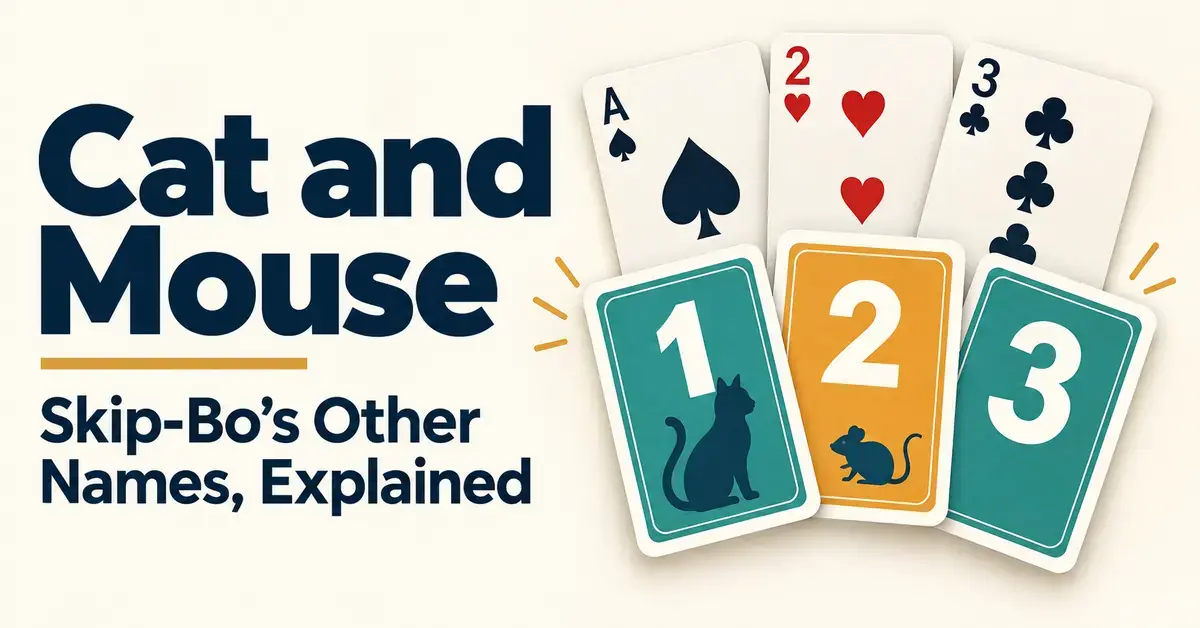
If you have heard someone call Skip-Bo by a different name, or stumbled onto a card game called “Cat and Mouse” that felt oddly familiar, you are not imagining the connection. Skip-Bo belongs to a family of sequence-building card games that has been played under several names for well over a century. This guide explains what the Cat and Mouse card game is, how it is played, and the various other names Skip-Bo and its ancestors go by, so you can tell them apart with confidence.
Key Facts
- Also known as: Cat and Mouse is another name for Spite and Malice.
- Relationship to Skip-Bo: Skip-Bo is Mattel’s commercial version of the same game.
- Players: Traditionally two; Skip-Bo supports two to six.
- Equipment: Cat and Mouse uses two 52-card decks; Skip-Bo uses its own 162-card deck.
- Goal: Be first to empty your personal pay-off (stock) pile.
- Family tree: Descends from Russian Bank (Crapette), which came from Double Klondike solitaire.
What is the Cat and Mouse card game?
“Cat and Mouse” is one of the common names for a two-player card game more widely known as Spite and Malice. It is a competitive form of patience (solitaire): instead of playing alone, two people race to empty a personal pile of cards by building shared sequences in the middle of the table. The name captures the mood of the game, because much of the fun comes from blocking your opponent’s plans while advancing your own.
Spite and Malice is a modern American game that took shape in the mid-20th century, but its roots run deeper. It is a reworking of the older game Russian Bank (also spelled and known as Crapette or Tunj), which itself grew out of Double Klondike, a two-pack form of solitaire. That lineage matters, because it is exactly why Cat and Mouse and Skip-Bo feel like relatives: they are branches of the same family tree.
How Cat and Mouse is played
Cat and Mouse (Spite and Malice) is traditionally played by two people using two standard 52-card decks shuffled together, although several versions let more players join. The core loop is simple once you have seen it once.
Setting up
- Pay-off pile: Each player is dealt a face-down pile of cards (commonly 20 or 30) called the pay-off or stock pile. The top card is turned face up. Emptying this pile is how you win.
- Hand: Each player draws a hand of five cards.
- Draw pile: The remaining cards form a shared draw pile between the two players.
Taking a turn
On your turn you first refill your hand back up to five cards. You then try to play cards to the centre building piles. A centre pile is always started with an Ace and built upward in sequence — Ace, 2, 3, and so on — regardless of suit. Cards can come from the top of your pay-off pile, from your hand, or from the top of your side stacks.
Kings are wild and can stand in for any card you need to keep a sequence going. A centre pile is built up to the Queen; once a pile reaches the Queen it is complete and set aside (or shuffled back into the draw pile), freeing space for a new Ace. You may play as many cards to the centre as you can, but the instant you place a card onto one of your own side stacks (personal discard piles built in any order), your turn ends and play passes to your opponent.
Winning
The first player to play the very last card from their pay-off pile wins. Because your best cards are often the ones your rival needs, timing and a little strategic blocking decide most games — hence “Spite and Malice.”
Skip-Bo’s other names and where they come from
Skip-Bo is the branded, self-contained version of this same idea. It was created in 1967 by Minnie Hazel “Skip” Bowman (1915–2001) of Brownfield, Texas, who hand-produced the first boxed sets. The name is often assumed to refer to skipping a turn, but it does not: it simply joins her own nickname, “Skip,” with her husband’s nickname, “Bo.” International Games purchased the game in 1980, and Mattel acquired it in 1992, turning it into the mass-market staple sold today. You can read more about what Skip-Bo is and where its name comes from in our dedicated overview.
Because Skip-Bo is essentially a packaged version of Spite and Malice, the two share a web of names. When people ask what Skip-Bo is “also known as,” the honest answer is that Skip-Bo itself is the trademark — but the underlying game answers to several titles.
Name Guide
| Name | What it is | Key detail |
|---|---|---|
| Skip-Bo | Mattel’s branded, self-contained version | 162-card deck; builds piles 1–12 with wild SKIP-BO cards |
| Spite and Malice | The traditional game and its most common name | Two 52-card decks; Kings wild; build Ace to Queen |
| Cat and Mouse | An alternative name for Spite and Malice | Same rules; popular in casual and family play |
| Russian Bank (Crapette / Tunj) | Older competitive-patience ancestor | A close cousin that Spite and Malice was reworked from |
| Double Klondike | Two-pack solitaire root of the family | The patience form the whole lineage grew out of |
Cat and Mouse versus Skip-Bo: what actually differs
The strategy and goal are nearly identical, so the real differences are in the equipment and a few numbers.
- The deck: Cat and Mouse uses two ordinary 52-card decks with suits and face cards. Skip-Bo comes with its own purpose-built deck of 162 cards — 144 numbered cards (1 through 12, twelve of each) plus 18 wild “SKIP-BO” cards. There are no suits.
- Building range: Cat and Mouse builds centre piles from Ace up to Queen, with Kings wild. Skip-Bo builds piles from 1 up to 12, with the SKIP-BO card acting as the wild.
- Players: Classic Cat and Mouse is a two-player duel; retail Skip-Bo is designed for two to six players, and can be played in teams.
- Accessibility: Skip-Bo’s numbered deck removes the need to translate suits and royal cards, which is why it is often marketed as family- and child-friendly.
If you want to see the branded rules end to end, our walkthrough of how to play Skip-Bo covers the stock pile, build piles, discard piles and wild cards step by step.
The wider name family: Spite and Malice, Russian Bank, Crapette
Cat and Mouse and Skip-Bo sit at the newest end of a long tradition. Understanding the older names helps explain why you may encounter the same game under different covers:
- Spite and Malice — the most common name for the traditional game and the one most rule books use.
- Cat and Mouse — an alternative name for the same game, popular in family and casual settings.
- Russian Bank / Crapette / Tunj — the older competitive-patience game that Spite and Malice was reworked from. It is a close cousin rather than the exact same game.
- Skip-Bo — the Mattel trademark for the packaged, custom-deck version.
Common mix-ups about the names
- “Skip-Bo means skipping a turn.” It does not; the word is simply a personal name.
- “Cat and Mouse is a different game from Spite and Malice.” They are the same game under two names, though house rules vary from group to group.
- “Skip-Bo and Cat and Mouse use the same cards.” Skip-Bo has its own numbered deck; Cat and Mouse uses standard playing cards.
- “Uno and Skip-Bo are the same because both are Mattel.” They share a publisher, not a game family — Uno is a matching game, while Skip-Bo is a sequence-building game.
Sources
Vanliga frågor (FAQ)
Is Cat and Mouse the same as Skip-Bo?
They are extremely close but not identical. Cat and Mouse is another name for Spite and Malice, the traditional game played with two standard 52-card decks. Skip-Bo is Mattel’s commercial version of that same game, played with a purpose-built deck of numbered and wild cards. The goal and strategy are the same; the equipment differs.
Why is it called Skip-Bo?
The name comes from its inventor, Minnie Hazel “Skip” Bowman, who combined her own nickname, “Skip,” with her husband’s nickname, “Bo.” Despite a common belief, it has nothing to do with skipping a turn during play.
What is Skip-Bo also known as?
Skip-Bo itself is a trademark, but the game it is based on goes by several names, most commonly Spite and Malice and Cat and Mouse. Its older ancestor is Russian Bank, also called Crapette.
How many players can play Cat and Mouse?
The classic version is a two-player game. Some variations allow more players, and the branded Skip-Bo edition supports two to six players, including team play.
Are Kings wild in Cat and Mouse?
Yes. In the traditional Cat and Mouse (Spite and Malice) rules, Kings are wild and can substitute for any card needed to continue a centre pile. Centre piles are built from Ace up to Queen, and a King helps bridge gaps in that sequence.
