
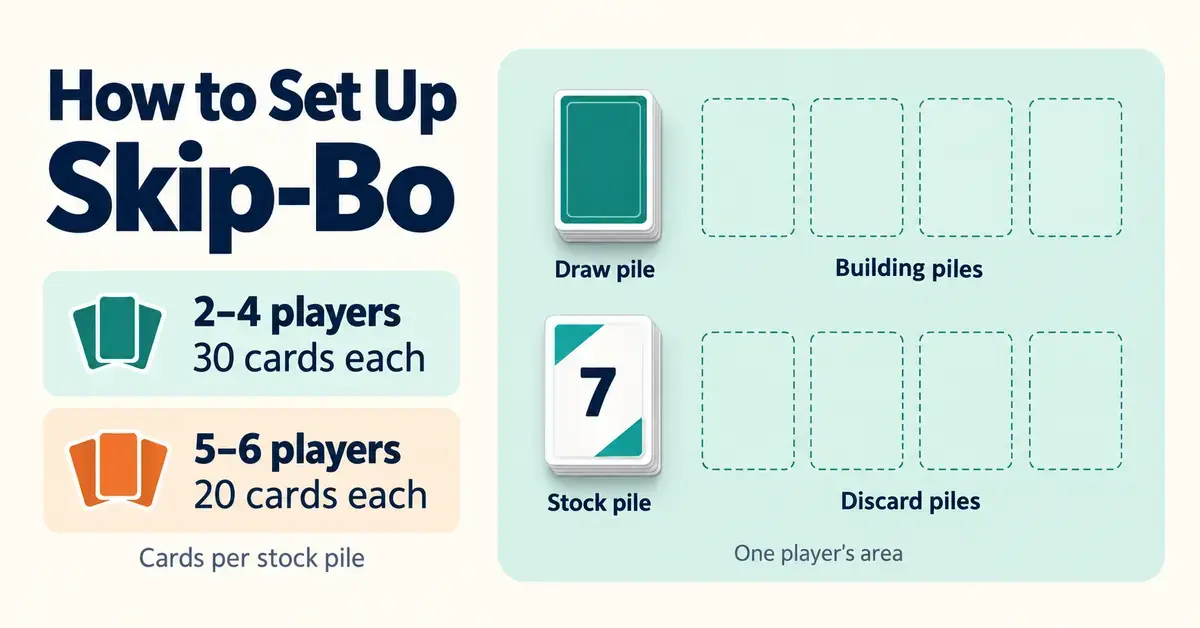
Before the first card is played, Skip-Bo needs a quick, correct setup — and the most common question new players ask is simply how many cards to deal. The short answer is 30 cards to each player when 2 to 4 people are playing, and 20 cards each for 5 or 6 players. This guide walks through the full setup: what is in the box, how to deal the stock piles, how to form the draw pile, and how to arrange the shared building piles and personal discard piles so your table is ready for the first turn.
Quick Facts
- Players: 2–6 (ages 7+)
- Deck: 162 cards — 144 numbered (1–12) plus 18 Skip-Bo wild cards
- Cards dealt per stock pile: 30 each for 2–4 players; 20 each for 5–6 players
- Short game option: 10 or 15 cards each
- Draw pile: all remaining cards, face down in the centre
- Hand size: draw up to 5 cards at the start of your turn
- Building piles: up to 4, shared, built upward 1→12
- Discard piles: up to 4 per player
- Goal: be the first to empty your stock pile
What you need before you deal
Skip-Bo is a sequencing card game for 2 to 6 players, aged 7 and up. A single deck is all you need. The official Mattel deck contains 162 cards: 144 numbered cards (twelve each of the numbers 1 through 12) and 18 Skip-Bo cards, which are wild and can stand in for any number.
If you are brand new to the game, it helps to first understand what Skip-Bo is and its goal. Every player is trying to be the first to empty their personal stock pile by playing those cards, in order, onto shared building piles in the centre of the table. Setting up correctly is what makes that race fair and clear.
Clear a flat surface big enough for a pile in front of each player plus a cluster of shared piles in the middle. Shuffle the full deck thoroughly before dealing — a good shuffle matters here, because the stock pile is dealt face down and its order is fixed for the whole game.
How to set up Skip-Bo step by step
Choose a dealer for the first game (any player). The dealer shuffles and then follows three steps.
1. Deal the stock piles
The dealer gives each player a face-down stack of cards that becomes their stock pile. Deal:
- 30 cards each for 2, 3 or 4 players
- 20 cards each for 5 or 6 players
Each player squares their stock pile into a neat stack and turns only the top card face up. That top card is the only one you can see; the rest stay hidden, face down, until you play down to them. Everyone can see the top card of every stock pile, which is part of the game’s tension.
2. Form the draw pile
Once every stock pile is dealt, the dealer places all the remaining cards face down in the middle of the table. This is the draw pile — the shared deck everyone draws from during play. Do not count or split it; whatever is left after the stock piles are dealt simply becomes the draw pile.
3. Leave room for the building and discard piles
No cards are dealt for these at setup, but you should leave space for them:
- Building piles: up to four shared piles in the centre, next to the draw pile. They start empty. During play they are built upward from 1 to 12, then cleared away and restarted.
- Discard piles: up to four piles in front of each player, for that player’s own use. These also start empty; you create them as you discard during your turns.
With the stock piles dealt, the draw pile in the middle and space set aside, the table is ready. For the full sequence of moves once play begins, see the complete guide on how to play Skip-Bo.
How many cards to deal in Skip-Bo
The number of cards you deal to each stock pile depends only on how many people are playing — and, if you want, how long you want the game to last. The table below sums it up.
How Many Cards to Deal
| Number of players | Cards dealt to each stock pile | Notes |
|---|---|---|
| 2 players | 30 | Standard game |
| 3 players | 30 | Standard game |
| 4 players | 30 | Standard game |
| 5 players | 20 | Larger group |
| 6 players | 20 | Larger group |
| Any count (short game) | 10–15 | Faster round; deal the same amount to everyone |
The key rule is that every player must start with the same number of stock-pile cards, so the race is even. Because the goal is to empty your stock pile, a bigger stock pile means a longer game.
Dealing fewer cards for a shorter game
If 30 cards feels like a long game, you can agree before dealing to use a smaller stock pile of 10 or 15 cards each. This is an official, sanctioned option for a faster round. Just make sure every player gets the identical amount, and remember that the leftover cards still form the draw pile.
Dealing the first hand and starting play
Setup ends and play begins with the first turn. The player to the left of the dealer goes first. To start a turn, you draw up to five cards into your hand from the draw pile.
- On your very first turn you draw a full hand of five cards.
- On later turns you only draw enough to bring your hand back up to five — so if you ended a turn holding two cards, you draw three.
From there you play cards onto the building piles in ascending order (a 1 starts a pile, then a 2, and so on), always trying to move the top card off your stock pile. A Skip-Bo wild card can fill any spot. You end your turn by placing one card from your hand onto one of your discard piles. Those mechanics belong to gameplay rather than setup — the point for setup is simply that the first player draws five and the game is underway.
Setup for 2 players vs. larger groups
The setup is the same for every group size except for the deal count. A two-player game and a four-player game are dealt identically — 30 cards each — and both use one deck. Only when you reach five or six players does the stock pile drop to 20 cards each, which keeps the draw pile from running too thin with more hands drawing from it.
If your group is larger than six, or you simply want longer games, some households combine two Skip-Bo decks. That is a house rule rather than an official setup, so agree on it before you shuffle.
Common Skip-Bo setup mistakes to avoid
- Dealing an uneven stock pile. Every player must get the same number of cards; miscounting one stock pile quietly breaks the balance of the game.
- Forgetting to flip the top stock card. Only the top card of each stock pile is turned face up. Leaving it face down hides the information the whole game is built around.
- Dealing building or discard piles. These start empty. No cards are handed out for them at setup — they fill up during play.
- Skimping on the shuffle. Because stock-pile order is locked in at the deal, a poor shuffle can hand someone an easy run of low cards. Shuffle well.
- Splitting the leftover deck. After the stock piles are dealt, every remaining card goes into one shared draw pile in the middle — it is not divided among players.
Sources
Frequently asked questions (FAQ)
How many cards do you deal in Skip-Bo?
Deal 30 cards to each player’s stock pile for 2 to 4 players, or 20 cards each for 5 or 6 players. For a quicker game you can agree to deal only 10 or 15 cards each, as long as every player gets the same amount.
How many cards are in a Skip-Bo deck?
A standard Mattel Skip-Bo deck has 162 cards: 144 numbered cards (twelve copies each of 1 through 12) and 18 Skip-Bo wild cards that can be played as any number.
What happens to the cards left after dealing the stock piles?
All the remaining cards are placed face down in the middle of the table to form the shared draw pile. Players draw from it at the start of each turn to fill their hand up to five cards.
How many cards do you start your hand with?
The player to the left of the dealer starts by drawing five cards. On every later turn, you draw only enough cards to bring your hand back up to five before you begin playing.
Do you deal cards to the building piles or discard piles when setting up?
No. The four shared building piles in the centre and each player’s up-to-four discard piles all start empty. They are filled during play, not during setup.
